
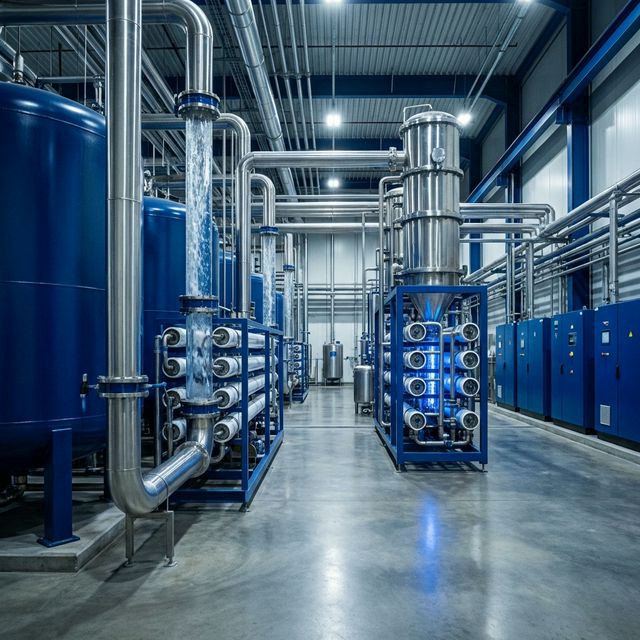
Faced with tightening environmental regulations and rising fresh water costs, modern industrial facilities are rapidly pivoting towards circular water economies. Xintai Environmental Protection engineers state-of-the-art Reclaimed Water Reuse (中水回用) and Zero-Liquid Discharge (ZLD) systems that capture factory effluent, completely purify it, and loop it back into core manufacturing processes.
By heavily combining advanced multi-stage filtration (Ultrafiltration + Reverse Osmosis) with advanced oxidation, these proprietary systems can recover up to 95% of industrial wastewater, drastically reducing both raw water intake constraints and municipal discharge fees.
Typical Treatment Process Flow
Secondary Effluent Collection Tank → Flocculation & Settling → Disc/Multimedia Filter → Ultrafiltration (UF) Membrane System → Activated Carbon Adsorption → High-Pressure Double-Pass Reverse Osmosis (RO) → Evaporation (for ZLD) → Reusable Pure Water Tank
Note: System configurations are highly customized based on the exact inlet water chemistry (such as COD levels, Ammonia Nitrogen, and Conductivity) to prevent membrane fouling and guarantee long-term stability.
Core System Features
-
Massive Operating Cost Reduction
By recovering upwards of 60-95% of plant water, factories immediately offset municipal fresh water purchasing and heavy discharge tariffs. -
Anti-Fouling Membrane Design
We exclusively deploy specialized wide-channel RO membranes built explicitly to resist biological and chemical scaling common in reclaimed wastewater. -
Regulatory Compliance & ESG
Empowers enterprise-level Environmental, Social, and Governance (ESG) goals by achieving strict Zero-Liquid Discharge (ZLD) mandates. -
Smart Analytics Integration
Full SCADA system monitoring automatically triggers membrane CIP (Clean-In-Place) cycles the moment operational pressure drops are detected.
Application Fields
Reclaimed Water solutions are vital for water-intensive industries including:
- Textile and Dyeing: Recovering massive volumes of hot, chemically-laden wash water.
- Pulp and Paper: Closing the water loop in heavy milling and bleaching processes.
- Petrochemical & Refining: Treating complex oily wastewater for cooling tower makeup water reuse.
- Large Commercial Real Estate: Greywater recycling for toilet flushing and landscaping.